
MongoDB Atlas: The Ultimate Guide to Document Databases
As we outlined in our post Machine Learning in Edge Computing, the world is generating data at an unprecedented pace. From the moment we wake up and check our smartphones to the countless background processes powered by sensors, apps, and artificial intelligence, we are constantly creating and consuming information. Every second, mobile phones, wearable devices, factory-based sensors, smart appliances, and autonomous vehicles produce a staggering amount of data.
This overwhelming flow of information demands powerful, flexible, and scalable data management systems. Traditional databases, while still useful in some areas, are often too rigid to adapt to the variety and speed of modern data. This is where document databases come in—and leading the way is MongoDB Atlas, a fully managed cloud database service that’s helping businesses manage data more intelligently than ever before.
What Is a Document Database?
A document database is a type of non-relational (NoSQL) database designed to store, retrieve, and manage document-oriented information. MongoDB’s document database guide explains how, unlike relational databases that store data in rigid tables with predefined columns and rows, document databases use flexible, semi-structured documents—typically in JSON or BSON format—to represent data.
Key Features of Document Databases:
- Schema flexibility: Each document can have a different structure, allowing for dynamic, real-world data modeling.
- Scalability: They’re built to scale horizontally, meaning they can handle large volumes of data with ease.
- Ease of development: Since the structure is similar to how data is represented in code (like JSON), developers can build applications faster.
- Performance: Documents are self-contained, reducing the need for complex joins and increasing query performance.
These features make document databases ideal for modern applications that require fast iterations, agile development, and the ability to handle unstructured or semi-structured data from a wide variety of sources.
Introducing MongoDB Atlas: A Leader in Document Databases
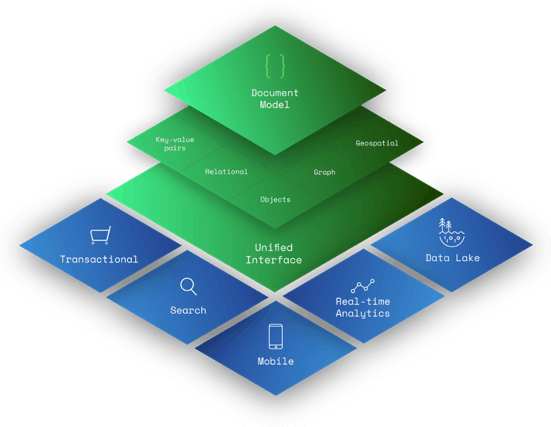
MongoDB Atlas is the cloud-based version of MongoDB, the world’s most popular document database. It provides a fully managed, globally distributed database service designed for modern application development. Whether you’re building a mobile app, a real-time analytics dashboard, or an AI-driven recommendation engine, Atlas offers the scalability, flexibility, and performance needed to support it.
Investor Business Daily reports that MongoDB Atlas has become a cornerstone of MongoDB Inc.’s business, accounting for approximately 76% of the company’s revenue as of 2025. This figure reflects not just the demand for cloud-based document databases, but also the growing reliance of enterprises on MongoDB’s feature-rich ecosystem.
What Makes MongoDB Atlas Stand Out?
- Fully managed service: Atlas handles all database maintenance tasks—patching, backups, monitoring, and scaling—so developers can focus on building applications.
- Global availability: Deploy across AWS, Google Cloud Platform, or Microsoft Azure, with multi-region and multi-cloud support.
- Advanced security: End-to-end encryption, fine-grained access controls, and compliance with major industry standards.
- Powerful integrations: Seamless integration with tools like Atlas Search (full-text search), Atlas Data Federation, and Atlas Vector Search for AI and ML applications.
- Real-time performance monitoring: Built-in dashboards and alerts help teams optimize query performance and system health.
MongoDB Atlas is not just a cloud database—it’s a comprehensive platform that meets the needs of modern, data-intensive applications.
The Evolution of the Document Database with MongoDB
Since its launch, MongoDB has been at the forefront of the document database movement, but its evolution has gone far beyond just storing documents. Over time, MongoDB has introduced a host of powerful features that blend the best aspects of traditional relational databases with the flexibility of NoSQL.
Key Milestones in MongoDB’s Evolution:
- Aggregation Framework: A powerful query language that enables data processing pipelines, similar to SQL’s GROUP BY or JOIN operations.
- ACID Transactions: Starting in MongoDB 4.0, the platform began supporting multi-document ACID transactions, closing the gap between NoSQL and relational systems.
- Time Series Data Support: Optimized storage and queries for time-series data, ideal for IoT and real-time analytics applications.
- Atlas Search: Built-in full-text search capabilities powered by Apache Lucene, eliminating the need for a separate search engine like Elasticsearch.
- Vector Search: MongoDB’s entry into the AI space, enabling fast similarity search over vector embeddings—perfect for recommendation systems, generative AI, and semantic search.
Each of these additions has expanded the scope of what a document database can do, making MongoDB a true general-purpose database that can compete with, and often outperform, traditional relational systems.
Why MongoDB Atlas Matters in Today’s Data-Driven World
The shift toward cloud-native development, combined with the explosion of data from digital devices, means organizations need databases that are resilient, scalable, and flexible. MongoDB Atlas is built precisely for this environment.
Whether it’s a startup building the next breakthrough app or an enterprise modernizing its infrastructure, Atlas provides the tools to store, query, and analyze complex data in real time, without the operational overhead of managing infrastructure.
As businesses continue to embrace AI, automation, and data-driven decision-making, document databases—and MongoDB Atlas in particular—will play a pivotal role in the digital transformation journey.
Conclusion
The modern world is built on data, and managing that data effectively has become a core challenge for businesses everywhere. With the surge in unstructured and semi-structured data from countless sources, traditional databases are no longer enough.
MongoDB Atlas represents the future of database technology—combining the agility of document-based data models with the power, reliability, and scale of a fully managed cloud service. As data continues to grow, so too will the importance of smart, flexible solutions like Atlas that can keep up with the pace of the modern world.