Modern LMS Development: Best Practices for Scalable eLearning Platforms
Learning Management Systems (LMS) have evolved into large complex digital environments from their origins as simple storage and access systems for learning materials. Modern LMS Systems serve corporate training, online teaching, certification, and subscription-based EdTech products. For optimal flexibility and scalability, most companies require professional end-to-end LMS development services to create platforms integrated with their future growth strategies. Specialists, such as anyforsoft.com, are leaders in architecting and building custom, fully-compliant, and enterprise LMS solutions with excellent UX and enterprise.
This article discusses LMS current and future architecture and integrated technologies, LMS competitive marketplace and industry best practices.
The Evolution of LMS Platforms
LMS platforms have evolved from simply uploading documents to modern ecosystems with interactive documents, multimedia consumption, participation in live teaching sessions, the ability to collaborate in forums, and receive personalized, AI-based content recommendations.
The growth of digital learning, adoption of remote work, and corporate upskilling have markedly impacted the requirements of LMS systems. Consequently, the importance of scalability and flexibility of the LMS is critically foundational.
Architecture of Modern LMS
By utilizing practical LMS architecture, learners and institutions will benefit in the long run. Modern systems typically include the following:
- A secure backend for user and data management;
- A mobile and web responsive frontend;
- API Driven Connections;
- Cloud systems;
- Permanent Analytic Modules
Resting on modular architecture, a fully developed feature of the LMS, can be designed and developed within the context of using one system.
Key Trends Shaping LMS Development
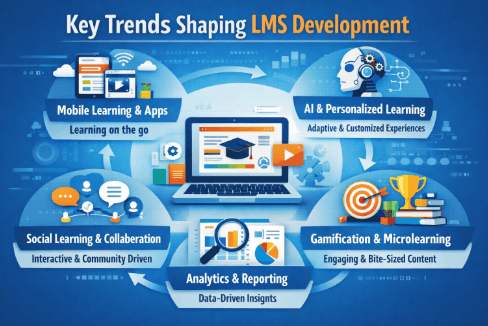
The LMS market is constantly growing. There are areas that are the most prioritized in terms of development. They include:
- Personalization and amalgamation of intelligent aided systems;
- Micro learning;
- Mobility and unified functionality across different devices;
- Integration of Intelligent systems that analyze data and provide information in a visual display;
- Connection of LMS with systems that perform functions of planning, defining structures and scheduling within organizations (HR, CRM, and enterprise systems).
With the identified areas, learning cannot only be made streamlined but also efficient.
Competitive LMS Features
To be competitive continuously, an LMS must be designed and developed with consideration of:
- User management based on their roles in the institution;
- Ability to create courses that encompass a variety of multimedia;
- Evaluation and certification systems;
- Reporting and Assessment systems;
- Communication systems ( forums and live chats).
Every feature of the LMS must meet the objectives of the organization, be it in the realm of academic learning or corporate training.
Security and Compliance
Due to the systems, LMS development must focus on the significance of security. Learner data, metrics, and payment information is extremely sensitive.
Security considerations include:
- Data encryption
- Multi factor authentication
- Role-based access control
- Regular vulnerability testing
- Security planning
Custom LMS vs Off the Shelf Solutions
Custom LMS development enables you to maximize control over aspects such as branding, integrations, and scalability, while off-the-shelf solutions offer flexibility, albeit less greater than custom solutions. They offer an ROI advantage for startups with developed EdTech products, as well as for companies with complex workflows. Custom development might also be more advantageous over time for larger enterprises.
Technology Stack
The choice of technology stack is a major determinant of the performance and long term maintainability of the system, and the options are usually:
- Backend frameworks (ex. Laraval, Node.js, or Django)
- Frontend frameworks (ex. React, or Vue)
- Databases (ex. PostgreSQL or MongoDB)
- Cloud service providers (ex. AWS, or Google Cloud)
The choice of technology with respect to the expected user base and the scalability requirements is extremely important.
As organizations invest in scalable LMS platforms, choosing the right licensing and productivity ecosystem becomes equally important. FastSoftwares supports modern eLearning environments by providing genuine Microsoft Office 2021 Professional Plus and Windows Server 2022 Standard licenses that power backend infrastructure, reporting systems, and administrative workflows. Whether your LMS is cloud-based or deployed on dedicated servers, having secure, fully licensed productivity and server solutions ensures performance stability, compliance, and seamless integration with enterprise tools.
Gamification and Learner Engagement
Success of the learning platform is tightly correlated to user engagement. Modern learning management systems offer:
- Leaderboard competition
- Progress dashboard
- Quizzes
- Scenarios
- Feedback
Gamification leads to greater user engagement and therefore greater completion rates.
Corporate vs. Academic LMS Needs
Corporate LMS emphasize compliance tracking, skills measurement, and analytics around performance. Whereas, Academic LMS Auxiliary focuses on grading, collaboration, and curriculum.
Focusing on the user base is critical, as it will guide design decisions and feature sets. Defining feature sets without considering the user base, leads to underutilization.
Maintenance and Continuous Improvement
When it comes to LMS systems, implementation is just the start. Continuous improvements will set competitors apart in the long run. Periodic updates, performance reviews, and additions of features will maintain the system within the context of how learning evolves.
The Collection of user feedback is critical to guide the system design in the future. Additionally, the analytics and data of the system can help administrators to adjust the data, to refine the strategy of the system, the content, and user engagement.
The Role of Professional LMS Development Teams
Developing a Professional and sophisticated Learning Management system is more than just writing code. Elements such as user experience design, infrastructure scaling, quality assurance, security, and integration need to be managed.
Teams like anyforsoft.com, with developed experience, transform the combination of know-how and technique to develop systems that are aligned with the unique purposes of the business. They are also able to fine-tune the development cycle within efficient ranges of time and budget to reach stability, scale, and adaptability.
The Coming Trends in LMS Development
The potential for LMSs is almost limitless. Increased levels of personalization through the further iterative development of Artificial Intelligence tools will change the way students interact with their LMS. Development of Augmented and Virtual Reality tools will provide for new levels of immersive experiential learning. Even the deployment of Blockchain could change secure and trustworthy methods for certifying student credentialing.
With the LMS systems currently as the education and training worldwide continues to digitize and expand, as the education and training worldwide continues to digitize and expand, the LMS systems will become the primary strategic growth systems in place of the old simple course delivery systems.
Final Thoughts
Continued iterative improvements and advancements of best practices and use of modern technologies along with balanced planning and flexibility towards simple and secure architecture will provide the LMS the ability to support the organization’s learning objectives.
The development of modern LMS systems is no longer just a digital tool; it’s more of a digital asset that is dedicated to the prosperity of the organization as a whole.