How to Improve Preventive Maintenance Compliance with Digital Tools and Cloud Solutions
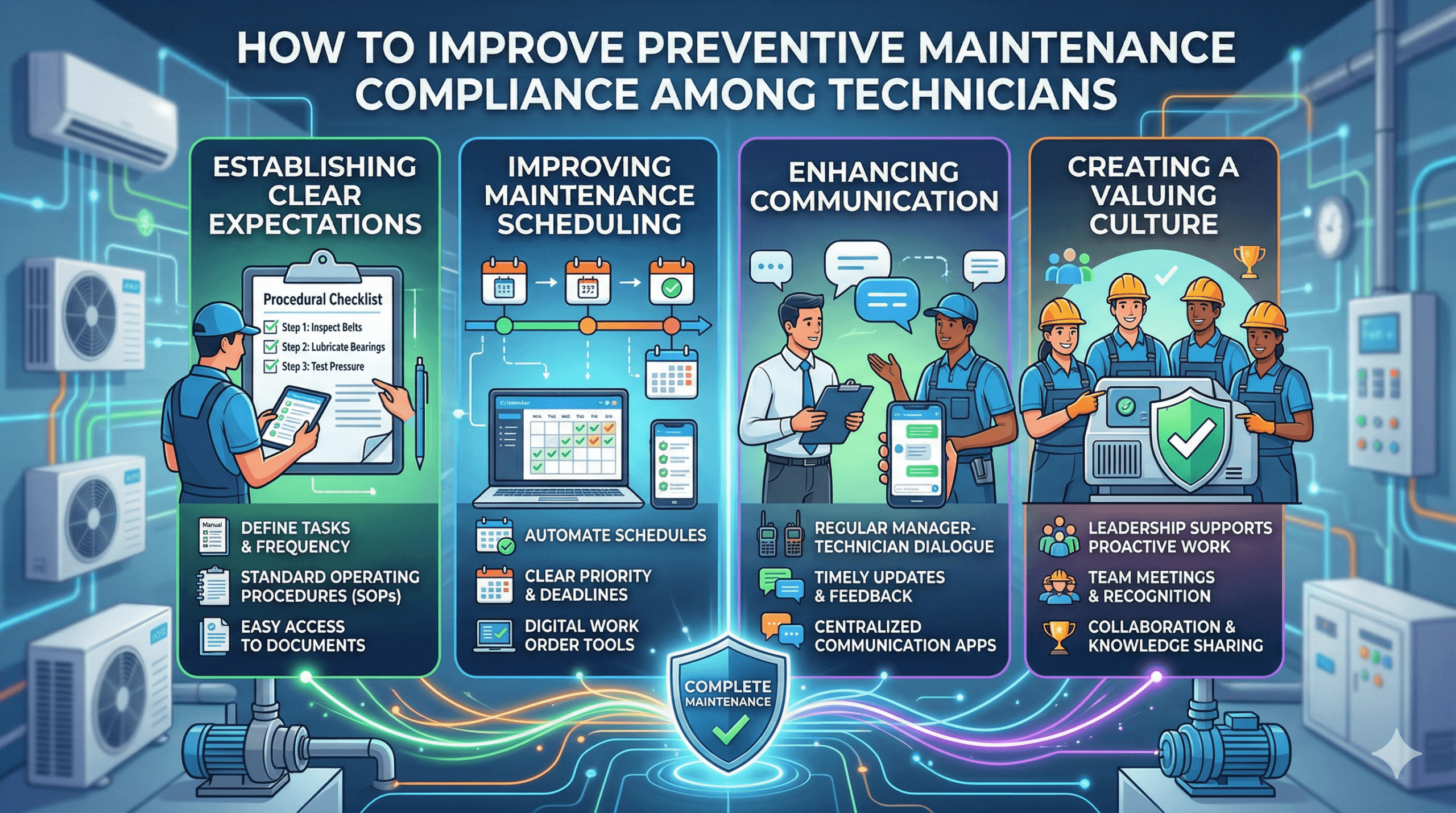
How to Improve Preventive Maintenance Compliance Among Technicians
Preventive maintenance is a critical aspect that helps in maintaining commercial equipment, building systems, and other operating assets in efficient operation. By regularly performing maintenance processes, organizations are able to minimize unexpected and unforeseen breakdowns, improve lifespan of equipment they use, and ensure good working conditions. The reality is, however, that it is not always simple to ensure high levels of adherence to preventive maintenance schedules. Technicians can be presented with conflicting priorities, undefined procedures, or ineffective communication systems and cannot easily accomplish preventive tasks in the given time.
Ensuring better control of preventive maintenance is a multiphase process of integrating clear expectations, effective scheduling, supportive tools, and effective communication. With the appropriate resources and processes given to technicians, it is more likely that maintenance teams will adhere to preventive schedules. Facility managers can establish a culture of maintenance where preventive maintenance is reliably and efficiently delivered by concentrating on practical improvements that assist technicians in their daily work.
Establishing Clear Maintenance Expectations
Technicians do their best work when maintenance expectations are outlined. The instructions used in preventative maintenance practices should be elaborate, clarifying the type of job to be done, the frequency at which it should be done and the outcomes which should be expected when the work is done. Technicians can perceive tasks in different ways or postpone them until clarification is received when the instructions are indistinct or irregular.
Maintenance leaders can enhance compliance by designing standard operating procedures in recurring preventive procedures. These practices ensure that technicians use the same steps whenever maintenance is done. Clarity in the documentation also eliminates confusion when various technicians handle the same equipment or where new staff members are added to the organization.
Better compliance is also achieved by providing reference materials that are easily accessible to technicians. Technicians feel more assured to get the preventive work right when they can quickly access maintenance instructions, equipment specifications, and safety guidelines. This simplicity lowers the chances of missing out maintenance steps and aids consistency in service level throughout the maintenance crew.
Improving Maintenance Scheduling Systems
Compliance with preventive maintenance frequently relies upon the ability to schedule and communicate tasks to technicians. Technicians tend to be disorganized when there is a lot of difficulty monitoring the maintenance schedules or when the schedules change frequently with no prior notification. When the assignments overlap or there is last minute introduction of tasks or not clearly defined deadlines, chances are high that preventive maintenance does not get done in time.
Enhancement in the scheduling systems can go a long way in enhancing technician adherence. Scheduled maintenance schedules enable the technicians to know their next duties and schedule their day based on these. By scheduling preventive tasks early enough, the technicians can use the right amount of time and stock to carry out the activity without the urge to hurry.
Maintenance scheduling can also be improved using digital tools. Maintenance management software is being used by many organizations to automate preventive schedules and assign tasks directly to technicians. These systems guarantee that maintenance activities are created at the appropriate times and stay noticeable until executed. Consequently, clear reminders are given to the technicians to keep them on track as far as preventive maintenance is concerned.
Enhancing Communication Between Managers and Technicians
Another important aspect of preventive maintenance compliance is good communication. Technicians are often exposed to dynamic work situations where equipment breakdowns, tenant requests, or emergency repairs may interfere with scheduled work. Preventative work can be postponed or overlooked when the bosses do not explain what needs to be done and when there is a high workload.
To enhance compliance, the managers should keep a routine communication with the maintenance teams on preventive priorities. When technicians realize the significance of preventive work and its impact on the functioning of the facility as a whole, they will view the preventive functions in a more serious manner and initiate the work in the same manner as the reactive repairs. Discussions on the reliability of equipment and the aim of functioning can support the importance of preventive maintenance.
Technicians should also be provided with timely updates with the help of communication tools. Maintenance requests and assignments that are centralized minimize the possibility that preventive tasks can be neglected. Indicatively, work order management software is used by many teams in handling tasks, monitoring progress, and ensuring task completion. In such a system technicians are made aware of their duties and supervisors can keep an eye on compliance in real time.
Another way to strengthen compliance is by securing maintenance data and reports through reliable backup and storage solutions. Tools like Microsoft OneDrive ensure that maintenance logs, inspection reports, and equipment records are automatically saved and protected from accidental loss. This allows technicians and managers to retrieve important data anytime, making it easier to track completed tasks, monitor performance, and maintain accurate maintenance history without disruption.
Creating a Culture That Values Preventive Maintenance
The sustainability of preventive maintenance regimes in the long term depends on the creation of a culture which accepts proactive maintenance practices. The moment technicians realize that the leadership appreciates preventative work and they devote time to it, they will become more willing to think of it as an inevitable component of their work.
Facility managers can reinforce this culture by constantly reinforcing the values of preventive maintenance with the teams during performance reviews and team meetings. To ensure that these technicians do not have only a vague idea of what their work is all about, it could be useful to give some examples of such preventive inspections as helping to prevent the expensive malfunction of the equipment.
By encouraging collaboration among the maintenance team, one is more likely to achieve compliance. Technicians will share experience, troubleshooting advice, and methods of maintenance thereby building knowledge around how to maintain equipment. This type of cooperative environment enables the technicians to be engaged in preventative maintenance matters and enhances the overall dependability of the facility operation.